
Difference in Khula and Faskh
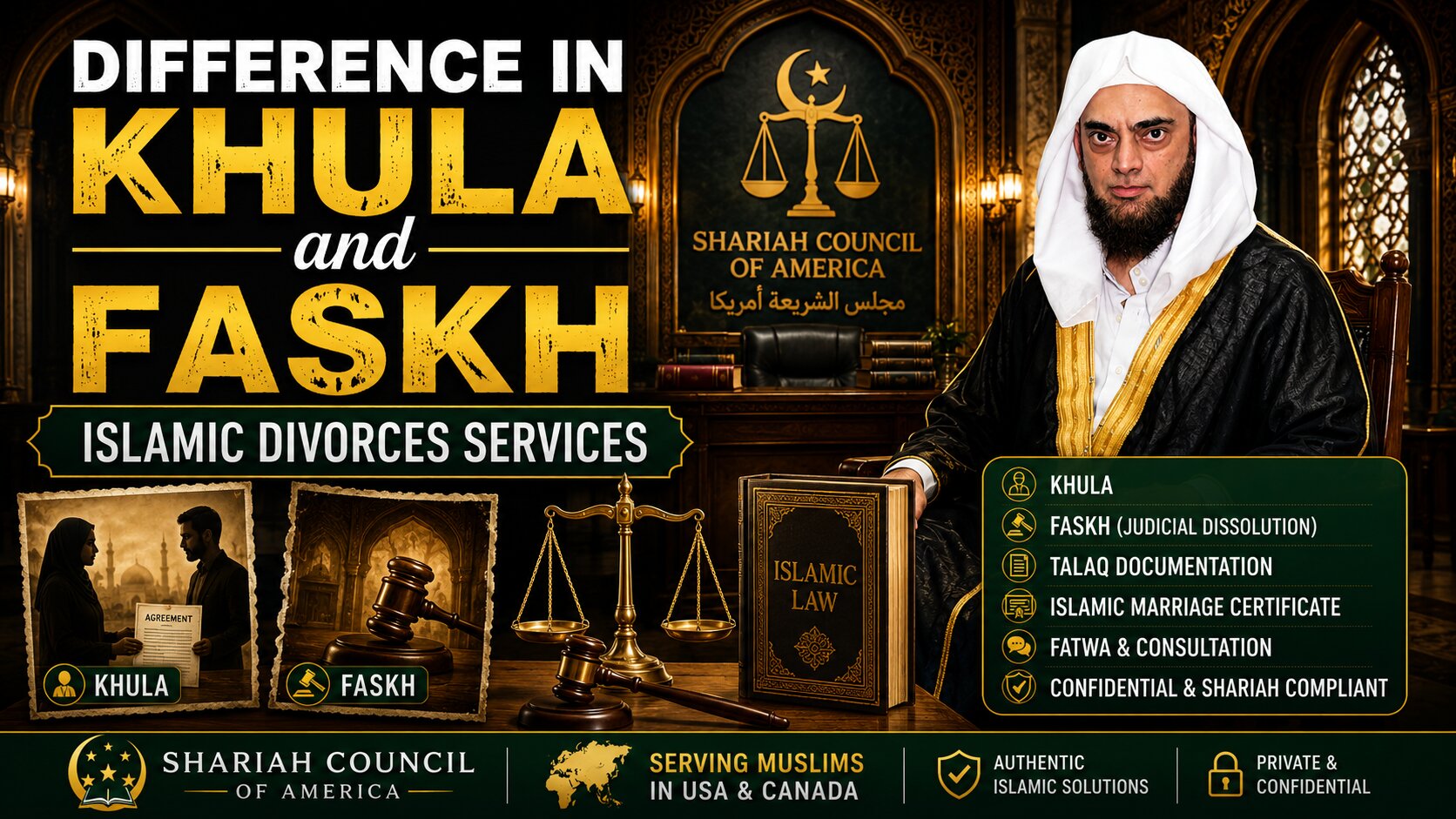
What Is the Difference Between Khula and Faskh? A Complete Guide to Islamic Divorce in the USA & Canada
Islamic marriage is built upon love, mercy, and mutual respect. However, Islam also recognizes that some marriages cannot continue due to irreconcilable differences, abuse, neglect, or other valid reasons. In such situations, Islamic law provides different methods for dissolving a marriage while protecting the rights of both spouses.
Two of the most commonly misunderstood forms of Islamic divorce are Khula and Faskh. Although both result in the dissolution of an Islamic marriage, they differ significantly in their legal basis, procedure, and requirements.
If you are searching for Islamic Divorce Services in the USA, Islamic Divorce in Canada, or guidance from an experienced Islamic Divorce Lawyer in USA, understanding these differences is essential.
What Is Khula in Islam?
Khula is an Islamic divorce initiated by the wife. It allows a woman to request the dissolution of her marriage when she no longer wishes to remain married, even if the husband has not committed a major wrongdoing.
The word Khula literally means “to remove” or “to take off,” symbolizing the removal of the marital bond.
In many cases, the wife agrees to return all or part of her Mahr (dowry) to the husband as compensation for ending the marriage, although this depends on the circumstances and Islamic legal rulings.
Common Reasons for Khula
A wife may request Khula because of:
- Loss of love or compatibility
- Constant marital conflict
- Emotional distress
- Lack of trust
- Personality differences
- Inability to fulfill marital obligations
- Fear that she cannot uphold the limits prescribed by Allah
Importantly, Khula does not always require proof of abuse or misconduct if the wife genuinely believes the marriage cannot continue Islamically.
What Is Faskh in Islam?
Faskh is the judicial annulment of an Islamic marriage by an Islamic authority, Mufti, Qadhi, or recognized Shariah Council.
Unlike Khula, Faskh is granted when there are legitimate Islamic grounds showing that the husband has violated his marital responsibilities or the marriage has become impossible to continue.
The authority reviews evidence before deciding whether to dissolve the marriage.
Common Grounds for Faskh
A wife may qualify for Faskh if the husband:
- Abandons the wife
- Refuses financial maintenance (Nafaqah)
- Commits domestic violence
- Is emotionally or physically abusive
- Has disappeared for a prolonged period
- Suffers from certain serious conditions recognized in Islamic law
- Imprisons the wife emotionally or prevents basic rights
- Refuses marital relations without valid reason
- Commits serious violations of Islamic marital obligations
Each case is assessed individually according to Islamic jurisprudence.
Key Differences Between Khula and Faskh
| Khula | Faskh |
|---|---|
| Requested by the wife | Granted by Islamic authority |
| Usually requires husband’s agreement (depending on circumstances and school of law) | Husband’s consent is not required if valid Islamic grounds exist |
| Wife may return Mahr | Return of Mahr may not be required |
| No misconduct necessarily required | Requires recognized Islamic grounds |
| Based upon mutual separation | Based upon judicial annulment |
Does the Husband Need to Agree to Khula?
In classical Islamic jurisprudence, Khula often involves the husband’s acceptance.
However, if the husband refuses unreasonably or uses his refusal to oppress the wife, many contemporary Islamic scholars and recognized Shariah Councils may intervene to protect her rights through other Islamic legal mechanisms, including Faskh where applicable.
Can a Wife Get an Islamic Divorce Without the Husband’s Permission?
Yes.
If the husband refuses to cooperate or cannot be located, an Islamic authority may review the circumstances.
Where valid Islamic grounds exist, the authority may grant Faskh, ending the marriage according to Islamic principles.
This protects women from remaining trapped in harmful or abandoned marriages.
Islamic Divorce Services in the USA and Canada
Many Muslims living in North America require an Islamic divorce that complies with Shariah while also respecting local legal systems.
The Shariah Council of America provides professional Islamic Divorce Services for Muslims throughout the United States and Canada.
Services include:
- Islamic Divorce (Talaq documentation)
- Khula
- Faskh (Judicial Dissolution)
- Marriage Verification
- Islamic Marriage Certificates
- Fatwas relating to family matters
- Consultation with qualified Islamic scholars
- Confidential case assessments
The Council assists clients regardless of state or province through secure online consultations.
Why Choose the Shariah Council of America?
The Shariah Council of America serves Muslims across the USA and Canada by providing authentic Islamic rulings based upon the Qur’an and Sunnah.
Their Islamic scholars carefully review each case individually while maintaining confidentiality, fairness, and compassion.
Whether your case involves Khula, Faskh, Talaq, or complex marital disputes, qualified scholars can guide you through every stage of the Islamic divorce process.
Islamic Divorce vs Civil Divorce
A civil divorce granted by a state or provincial court may not automatically dissolve an Islamic marriage.
Many Muslim couples seek both:
- Civil Divorce through the courts
- Islamic Divorce through a recognized Islamic authority
Obtaining both helps ensure that the marriage is legally and religiously concluded.
Frequently Asked Questions
Is Khula the same as divorce?
No. Khula is a specific form of Islamic divorce initiated by the wife, whereas Talaq is generally initiated by the husband.
Is Faskh permanent?
Yes. Once Faskh is validly granted according to Islamic law, the marriage is dissolved.
Can I apply online?
Yes. Many Islamic organizations, including the Shariah Council of America, offer online Islamic divorce services for clients throughout the USA and Canada.
How long does an Islamic divorce take?
The timeline depends on the complexity of the case, cooperation of the parties, and the evidence required.
Conclusion
Understanding the difference between Khula and Faskh is crucial for Muslims seeking an Islamic divorce in North America. Khula allows a wife to seek separation when she no longer wishes to continue the marriage, while Faskh is a judicial dissolution granted on recognized Islamic grounds when the husband has failed in his marital responsibilities or other valid reasons exist.
If you require Islamic Divorce Services in the USA, Islamic Divorce in Canada, Khula, Faskh, or guidance from qualified Islamic scholars, the Shariah Council of America provides confidential, professional assistance in accordance with the Qur’an and Sunnah.
Where to File Khula in USA
Difference Between Khula and Faskh | Islamic Divorce Services USA & Canada | Shariah Council of America
How to File Khula in America & Canada
Learn the difference between Khula and Faskh in Islam. Discover Islamic Divorce Services in the USA and Canada offered by the Shariah Council of America, including Khula, Faskh, Talaq, and guidance from qualified Islamic scholars.
Islamic Divorce Services in USA & Canada
- Difference between Khula and Faskh
- Khula in Islam
- Faskh in Islam
- Islamic Divorce USA
- Islamic Divorce Canada
- Islamic Divorce Services USA
- Islamic Divorce Lawyer in USA
- Islamic Divorce Attorney USA
- Muslim Divorce Lawyer USA
- Shariah Council of America
- Islamic Khula USA
- Faskh Islamic Divorce
- Muslim Family Law USA
- Islamic Marriage Dissolution
- Online Islamic Divorce USA
- Islamic Divorce Certificate USA
- Islamic Divorce Consultation
- Islamic Divorce for Muslims in America
- Khula Services USA
- Islamic Family Law Canada